As I work on a funding application while drinking my complimentary beverage at the hotel bar overlooking the Panama canal, I can finally take a breath and reflect on my last two months of field work. Last in the sense of just happened, but also in that I only have lab work, data analysis, and writing to look forward to in the last two years of my Ph.D. Currently, I am truly content. Ask me about my happiness just four days ago when I was completely covered in coral goo, and I might have had a few choice words to say about my situation. Don’t worry, I’ve showered by now. But I’m getting ahead of myself.
January 3rd, I arrived in Bocas del Toro, Panama for my last field work trip at the Smithsonian Tropical Research Institute. Over the last year, I have monitored the same area of reef for changes in coral health related to increasing temperatures. Coral bleaching, the phenomenon when corals kick out their algal symbionts and appear white because of their underlying skeleton, occurs when ocean temperatures are too hot for corals and they become stressed. My year-long study looked at nine different coral species at two different depths. I took samples from tagged corals at four different times: initial, during the first high temperature event in July, during the longer and hotter event in October, and after a recovery period this January. My research should be able to capture any possible changes in these corals and their symbiont associations as they dealt with environmental stress over the past year. But I won’t know anything until I get back in the lab and get my ~1000 samples sequenced. If you need to find me anytime in the next year, I’ll be at the lab bench.

During this last trip, I ran a tank experiment studying how different coral species, picked based on how their polyps are connected, deal with a physical injury. Don’t know what I mean by polyps? Picture small sea anemones or upside down jellyfish living together on top of a rock that they built together, and then all of the individuals are connected by an internal plumbing system. Coral’s only have two layers of tissue (whereas we have three) and they don’t have blood or a circulatory system, but they do have their internal plumbing – the gastrovascular system – which may play a part in how these colonial organisms can recover from an injury.
My experiment involved collecting 72 fragments of coral from the reef and blasting a little over half of them with a water-pick – the thing the dentist uses to clean your teeth. I then watched (and took photos) as the corals regrew their tissue for five weeks. The slow-motion process is not very riveting, but the weekly time-lapse is pretty cool.


Ok, now that you have an idea of what I’ve been working on, let me recap the events leading up to my being completely exhausted and covered in coral. By mid-February, conditions out on the reef were terrible – 10ft swell over the reef crest, ripping currents, and 5ft or less visibility. I tried to get out to my permanent site one last time, but I had a new boat driver, and even with coordinates, I couldn’t find my part of the reef because I couldn’t see the reef until I was right on top of it. So I didn’t get to say goodbye to my corals, but I did get to practice the lost-buddy-return-to-surface dive safety drill! It’s amazing that after over 100 dives on the same reef, I still have trouble finding my site. On a good day, I know exactly where both depths are and can navigate between the two sites, the general location of each tag number, and can find the resident seahorse. That was my Sunday, and the following Wednesday was the “demolition” day for my tank experiment. My week was not off to a good start.
Heading into demo-day, I realized that I had to kill all of my experiment corals to be able to measure the dry weights of their skeletons, a measure combined with wet weights and used in determining coral growth rates. I had been planning to return them all to the reef to ease my guilt from taking them off the reef in the first place. I settled on making a $30 donation to the coral restoration foundation instead. The only instrument I had for removing the coral tissue was the waterpick that I used to make the small, precise injuries. The waterpick sprays a focused jet of pressurized water on the coral, thus the jet also causes the tissue to splatter everywhere. And that, my readers, is how I ended up completely covered in coral goo. We’re talking like late 90’s Nickelodeon slime level goo. For an animal with only two layers of tissue and a layer of mucus (snot) on top, corals can sure make a lot of goo. Disgusting. I had to wear goggles or sunglasses to protect my eyes. This is one of those overly-honest methods moments that I’m slightly ashamed to admit happened… but as I was in a remote field location, my alternatives were pretty limited. I remember wishing for the flesh-eating beetles featured on the TV show Bones, but alas, there was no resident insect biologist at the Smithsonian that week. By the end of blasting tissue off of 4/6 tanks worth of corals, the sun was setting and I could no longer see what I was doing through my sunglasses. I was beaten.
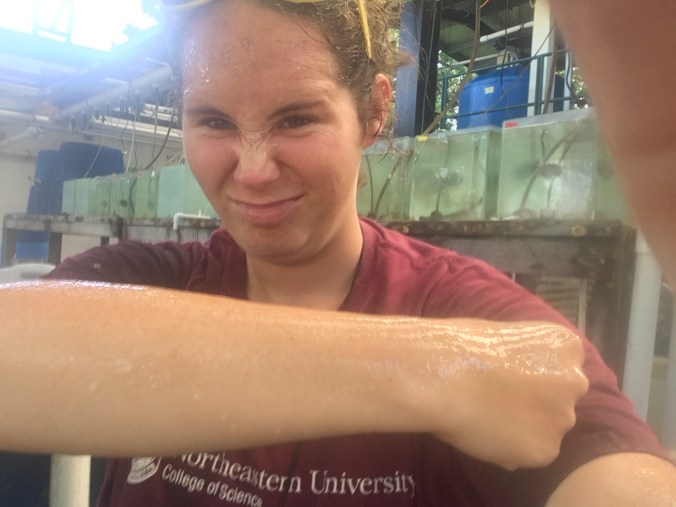
So I ran to the dock, then ran right off into the blue-green Caribbean waters, and I laughed. Because, even though at that moment in time, I felt a bit defeated by an animal without a brain, I couldn’t help but realize that I was happy. In the last year, I have struggled with the stress and demands of doing a Ph.D. and have questioned my choices multiple times. But in that moment, when things felt like they were falling apart, I fell back in love with my Ph.D.
Sometimes you just have to be forehead deep in the blasted-tissue of your study species, before you jump off a dock to remember that life is funny and you truly love what you do. The last year-ish of my life has been the craziest, stressful, adventurous, disgusting at times, wonderful, anxiety inducing, yet self-affirming, amazing time of my life, and I wouldn’t have it any other way. I’m going to miss Bocas and the #FieldWorkLife, but I can’t wait to get into my data and start piecing together my results.

 Sara Dell Williams