Last weekend, I participated in my first ever hackathon, Sourcing Boston: A food security and resilience hackathon hosted by Northeastern.
I’ve been working on quantifying the resistance and robustness of coral symbiosis under climate change throughout the first few years of my Ph.D. and now I’m starting to work on the resilience piece of the puzzle. Since I’m broadly interested in questions of resistance and resilience of systems to climate change, the event caught my eye.
For those of you unfamiliar with hackathons (which was me a little over a week ago), they usually last a day or two and consist of a bunch of people who like to solve problems splitting into teams to tackle an issue. In the case of the hackathon I attended, that issue was Boston’s food security. Project Bread and Red Tomato, two organizations focused on healthy food availability, supplied extra data sets on top of the City of Boston’s already great data resources.
I joined a team that wanted to tackle the impact of climate change and extreme weather events on Boston’s food access. We also had some data, provided by Daisy Tam, on produce prices in Hong Kong, but were unable to find a comparable data set for Boston. An overview of my team’s process and the data files used to make the map below can be found on my GitHub repository for the project. My team started out ambitious and had so many awesome questions about how storms and flooding affect food access, but in the end, our final product was limited by time and data accessibility. I ended up visualizing Boston food retailers, food accessibility, social vulnerability, and sea level rise scenarios in one interactive map. And we won second place! Below I’ve included the map I made and some other results from the project. As you continue reading, please remember that I am a global change biologist / network scientist… not a social scientist with a focus on food access. So please consider the below analyses with that in mind.
While making the map, I found that a lot of the data I wanted to visualize had already been mapped… just in different places. The City of Boston has an awesome map of climate change and social vulnerability data, but it didn’t have any data on food accessibility visualized. So I combined data sets on food retailers, retailers that accept SNAP (Supplemental Nutritional Assistance Program), the Greater Boston Food Bank, and one of the major food distributors in the area – New England Produce Center – to get an idea of where food access points are in the city. I then mapped that combined data set with a subset of the climate ready Boston and social vulnerability data. For more information on the data sets, check out my Github.
I hope this map can serve as a starting point to ask more questions about the impact of climate change on Boston’s food accessibility. One direction that I would have liked to go in had I had the right the data, would have been to look at the supply chain network and how it gets “attacked” by flooding. What pathways are weak links for the system when flooded? Where is the supply chain most disrupted by storms? What retailers are cut off during extreme weather? How does flooding affect access to food for Boston’s socially vulnerable populations?
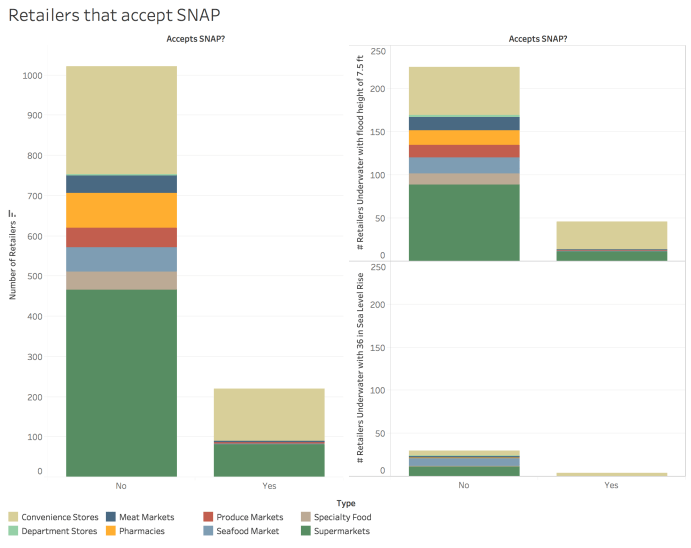
An interesting insight from this preliminary analysis is shown in the figure below. Supermarkets and grocery stores account for less than 50% of retailers who accept SNAP. People who have to rely on SNAP to purchase food have severely limited retailer options. Unless convenience stores have a large variety of food choices, it appears that Boston has a healthy food accessibility problem. Add in climate change and the food accessibility problem gets worse. During a 7.5ft storm flood at high tide, predicted in 100 years, a quarter of all retailers accepting SNAP will be flooded, while only a tenth of all other food retailers will be underwater.
I had an awesome first hackathon, especially considering that my team came in second place! The event was an exercise in teamwork and collaboration, focus, quick-data skills, and picking up new visualization tools. I had fun asking new questions while reminding myself that an old dog (or in my case, a very focused-PhD candidate) can learn new tricks.
 Sara Dell Williams