Women in Network Science Seminar Recap

I was invited to give a seminar on 10/14/20 for the Women in Network Science Seminar series (WiNS seminars) hosted by a fellow woman in network science and wonderful human, Alice Schwarze. The WiNS seminar series is one of the few good things to come out of this pandemic. If you missed my seminar, check out the recording and abstract below!

ABSTRACT: As coral reefs struggle to persist under a multitude of threats, understanding the resistance and resilience of these complex systems is a central goal of coral reef biology and ecology. Different coral species associate with different species of symbiotic algae (Symbiodiniaceae), creating a complex network of symbiotic associations on a reef. This symbiotic relationship is vulnerable to increasing temperatures. Coral bleaching is the breakdown of the association between the coral host and its endosymbiotic algae in response to stressful temperatures. We analyzed a global network of coral-symbiont associations for resistance to temperature stress and robustness to various perturbations. Our novel bleaching model determined resistance of the networks to increasing temperature by removing links when the environmental temperature surpassed their weight, a temperature threshold for individual host-symbiont pairs based on known physiological responses. Ecological robustness, defined by how much perturbation is needed to decrease the number of nodes by 50%, was determined for multiple removal models that considered traits of the hosts, symbionts, and their associations. We show that the global network of associations between corals and Symbiodiniaceae and its distribution of thermal tolerances are non-random, and the evolution of this architecture has led to higher sensitivity to environmental perturbations. By limiting our spatial scale and expanding our temporal scale, we can start to answer questions about reef resilience. To do this, I repetitively monitored and sampled a coral-Symbiodiniaceae network in Bocas del Toro, Panama from January 2017 to January 2018, during which the reef experienced two high-temperature bleaching events. We explored how Symbiodiniaceae communities varied across host species, depth, and time. Temporal networks of the symbiotic associations were used to assess differences in association patterns that led to structural and/or functional resilience to repeat heat stress events. I define structural resilience as a system’s ability to either resist changing the structure of associations or return to the initial structure after a disturbance. Functional resilience is a system’s ability to recover in relation to its health and function, but it may also undergo structural changes during that recovery. Structures of Symbiodiniaceae co-occurrence networks and coral-symbiont networks varied through time indicating that on a reef scale, the coral-symbiont associations responded to changing environmental conditions.

So you want to go to graduate school for Marine Science?

Intro and note:

     This is a compilation of google searches, personal thoughts, and crowd-sourced advice on applying for graduate school, with a focus on grad schools in Marine Science. It was initially developed as additional resources for a presentation to the interns at Mote Marine Lab in Sarasota FL during the summer of 2017. So if there are any specific dates listed below, check that they are current. Make sure that you check the most up-to-date websites and information for funding/fellowship due dates and required application materials, and do not rely only on the information I’ve posted below.

I only applied to one graduate school to work with one advisor who I had already worked for as a technician for a year and a half at Northeastern and as an undergrad at the College of William and Mary. My advisor and I work well together, he supports me as I pursue the research that I am passionate about, and I have my own funding (NSF GRFP). This path does not work for everyone, which is why I highly recommend applying to multiple schools and funding sources. I hope that if you have stumbled upon this blog post that you find it helpful, and good luck!

Some crowd-sourced advice from grad students at Northeastern:

  • Start conversations well before applying – like in the spring
  • Find people who are doing interesting stuff
  • Start by asking “Are you accepting students?”
  • Watch your grammar!
  • Talk to graduate students
  • Don’t rush in
  • Make sure it’s right for you
  • Make sure you are doing the right project
  • Ask yourself “What are your professional goals?”
  • Go to meetings if you can, and talk to people
  • Talk to your undergrad advisor, they know people
  • Use a directory like evoldir
  • Advisors like to get a professional email as an introduction
  • Get on Twitter! It’s a great way to learn more about different labs and hear about open positions.

Links to Useful Blogs and Websites:

Resources for finding open positions:

Resources for Fellowships and Funding:

  • The Big Ones:
    • National Science Foundation Graduate Research Fellowship (NSF GRFP)
      • General website: https://www.nsfgrfp.org
      • Read the Solicitation in full when applying.
      • Generally due late October, different fields have different due dates
      • 3 References are due slightly later, usually first few days of November
      • When can you apply / how many times?
        • As an undergrad senior or when you are also applying for grad school
        • Grad students are limited to only one application during first or second year only
        • “Applicants who have completed more than twelve months of graduate study or have earned a previous graduate or professional degree are eligible only if they have had an interruption in graduate study of at least two consecutive years prior to November 1 of the year the application is submitted. To be eligible, applicants must have completed no additional graduate study by August 1 of that year. Applicants must address the reasons for the interruption in graduate study in the Personal, Relevant Background and Future Goals Statement.”
        • Also, you have to be a US citizen
      • How much support?
        • Max of 3 years of financial support
        • Stipend is currently $34,000 for a 12 month tenure
        • Some research allowance, but depends on your institution
        • Have to use a full year at a time, can’t break it up into semesters
        • Access to more funding through the Graduate Research Internship Program and Graduate Research Opportunities Worldwide (GRIP AND GROW)
        • Cyberinfrastructure resources available
      • Very Competitive.
      • Application materials:
        • Background info in Fastlane
        • Electronic Transcripts
        • 3 references
        • Personal, Relevant Background, and Future Goals Statement (3 pages)
        • Graduate Research Plan Statement (2 pages)
      • Notified in early April, award about 2,000
    • NOAA Dr. Nancy Foster
      • General Website: http://fosterscholars.noaa.gov
      • Particularly for female and minority students
      • Only award 2-4 a year, highly competitive
      • For NOAA mission-related sciences: have to tailor it to NOAA’s goals
      • Deadlines:
        • Application process opens in October
        • Usually due in early December
        • Announced in May
      • Restrictions:
        • Only US citizens at US institutions
        • Pursuing an advanced degree in oceanography, marine biology, maritime archaeology, and all science, engineering, social science, and resource management disciplines involving ocean and coastal areas
        • Can apply during all stages of masters and Ph.D. studies, even when applying to schools
        • Have and maintain a GPA of 3.3 or higher and full time student status
      • How much support?
        • Yearly allowance of $42,000 (12-month stipend of $30,000 and $12,000 education allowance)
        • Up to $10,000 of support for a 4-6 week program collaboration at a NOAA facility
        • Master students are supported for up to 2 years
        • Ph.D. students are supported for up to 4 years
      • Application Materials:
        • Standard Form 424
        • Table of contents
        • General info sheet
        • Statement of interest
        • Transcripts
        • Enrollment verification/schools applied to
        • Transcripts
        • Research proposal
        • Two letters of recommendation
        • Statement of financial need
        • Declaration statement
    • EPA Science to Achieve Results (STAR) Graduate Fellowships
    • National Defense Science and Engineering Graduate Fellowship (NSDEG)
      • https://ndseg.asee.org
      • Similar to the GRFP
      • Usually fund more applied oceanography research
      • Applications open in September, Due early December
  • Some other links for fellowship/funding resources to checkout:

First Hackathon, Second Place: Visualizing the Impact of Sea Level Rise on Boston’s Food Security

Last weekend, I participated in my first ever hackathon,  Sourcing Boston: A food security and resilience hackathon hosted by Northeastern.

I’ve been working on quantifying the resistance and robustness of coral symbiosis under climate change throughout the first few years of my Ph.D. and now I’m starting to work on the resilience piece of the puzzle. Since I’m broadly interested in questions of resistance and resilience of systems to climate change, the event caught my eye.

For those of you unfamiliar with hackathons (which was me a little over a week ago), they usually last a day or two and consist of a bunch of people who like to solve problems splitting into teams to tackle an issue. In the case of the hackathon I attended, that issue was Boston’s food security. Project Bread and Red Tomato, two organizations focused on healthy food availability, supplied extra data sets on top of the City of Boston’s already great data resources.

I joined a team that wanted to tackle the impact of climate change and extreme weather events on Boston’s food access. We also had some data, provided by Daisy Tam, on produce prices in Hong Kong, but were unable to find a comparable data set for Boston. An overview of my team’s process and the data files used to make the map below can be found on my GitHub repository for the project.  My team started out ambitious and had so many awesome questions about how storms and flooding affect food access, but in the end, our final product was limited by time and data accessibility. I ended up visualizing Boston food retailers, food accessibility, social vulnerability, and sea level rise scenarios in one interactive map. And we won second place! Below I’ve included the map I made and some other results from the project. As you continue reading, please remember that I am a global change biologist / network scientist… not a social scientist with a focus on food access. So please consider the below analyses with that in mind.

While making the map, I found that a lot of the data I wanted to visualize had already been mapped… just in different places. The City of Boston has an awesome map of climate change and social vulnerability data, but it didn’t have any data on food accessibility visualized. So I combined data sets on food retailers, retailers that accept SNAP (Supplemental Nutritional Assistance Program), the Greater Boston Food Bank, and one of the major food distributors in the area – New England Produce Center – to get an idea of where food access points are in the city. I then mapped that combined data set with a subset of the climate ready Boston and social vulnerability data. For more information on the data sets, check out my Github.

I hope this map can serve as a starting point to ask more questions about the impact of climate change on Boston’s food accessibility. One direction that I would have liked to go in had I had the right the data, would have been to look at the supply chain network and how it gets “attacked” by flooding. What pathways are weak links for the system when flooded? Where is the supply chain most disrupted by storms? What retailers are cut off during extreme weather? How does flooding affect access to food for Boston’s socially vulnerable populations?

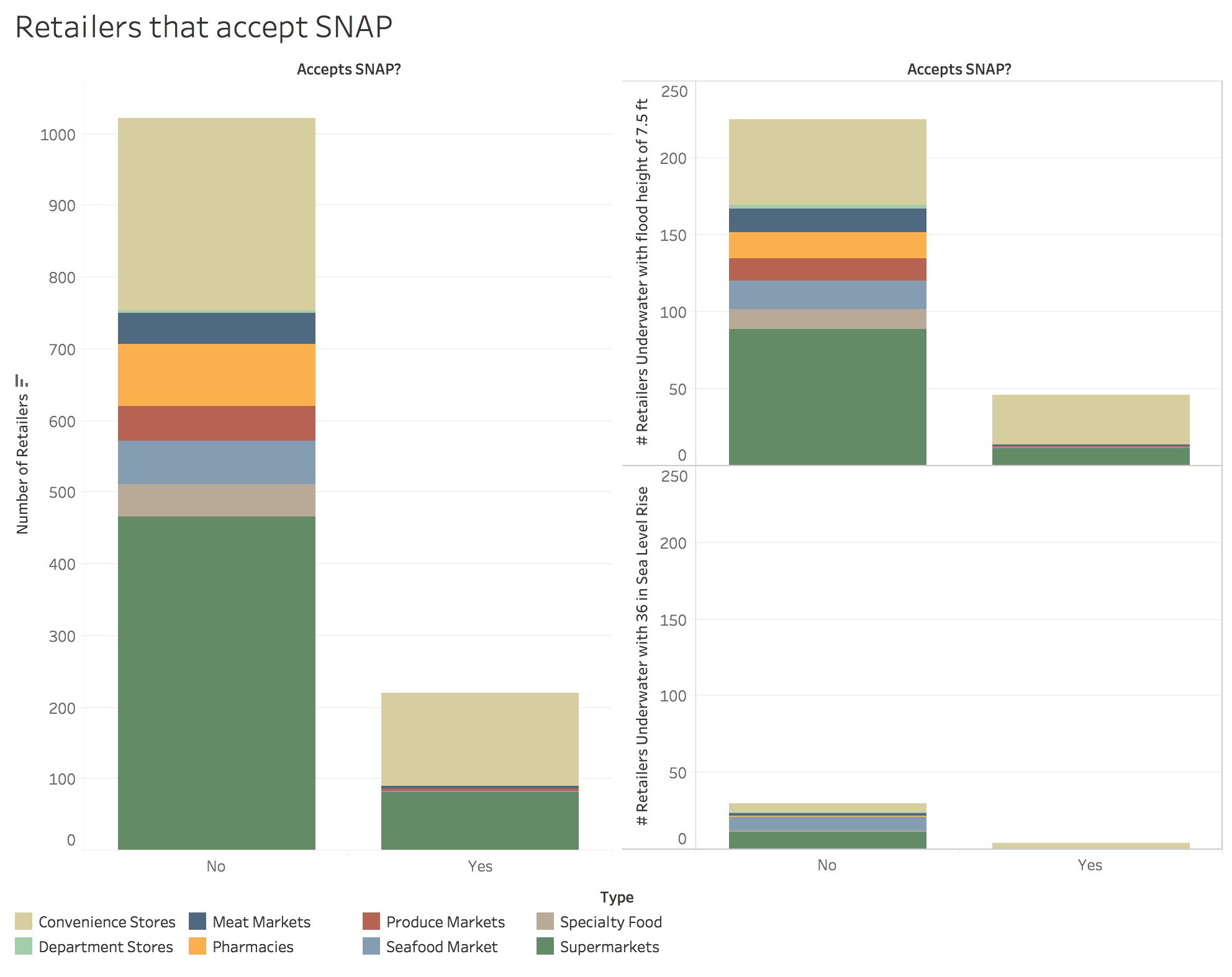
An interesting insight from this preliminary analysis is shown in the figure below. Supermarkets and grocery stores account for less than 50% of retailers who accept SNAP. People who have to rely on SNAP to purchase food have severely limited retailer options. Unless convenience stores have a large variety of food choices, it appears that Boston has a healthy food accessibility problem. Add in climate change and the food accessibility problem gets worse. During a 7.5ft storm flood at high tide, predicted in 100 years, a quarter of all retailers accepting SNAP will be flooded, while only a tenth of all other food retailers will be underwater.

Screen Shot 2018-11-17 at 1.20.58 PM.png


I had an awesome first hackathon, especially considering that my team came in second place! The event was an exercise in teamwork and collaboration, focus, quick-data skills, and picking up new visualization tools. I had fun asking new questions while reminding myself that an old dog (or in my case, a very focused-PhD candidate) can learn new tricks.

Research Update: Covered in Coral Goo and Still Laughing about it.

As I work on a funding application while drinking my complimentary beverage at the hotel bar overlooking the Panama canal, I can finally take a breath and reflect on my last two months of field work. Last in the sense of just happened, but also in that I only have lab work, data analysis, and writing to look forward to in the last two years of my Ph.D. Currently, I am truly content. Ask me about my happiness just four days ago when I was completely covered in coral goo, and I might have had a few choice words to say about my situation. Don’t worry, I’ve showered by now. But I’m getting ahead of myself.

January 3rd, I arrived in Bocas del Toro, Panama for my last field work trip at the Smithsonian Tropical Research Institute. Over the last year, I have monitored the same area of reef for changes in coral health related to increasing temperatures. Coral bleaching, the phenomenon when corals kick out their algal symbionts and appear white because of their underlying skeleton, occurs when ocean temperatures are too hot for corals and they become stressed. My year-long study looked at nine different coral species at two different depths. I took samples from tagged corals at four different times: initial, during the first high temperature event in July, during the longer and hotter event in October, and after a recovery period this January. My research should be able to capture any possible changes in these corals and their symbiont associations as they dealt with environmental stress over the past year. But I won’t know anything until I get back in the lab and get my ~1000 samples sequenced. If you need to find me anytime in the next year, I’ll be at the lab bench.

26910289_10156055219914660_3339454401181628758_o.jpg

During this last trip, I ran a tank experiment studying how different coral species, picked based on how their polyps are connected, deal with a physical injury. Don’t know what I mean by polyps? Picture small sea anemones or upside down jellyfish living together on top of a rock that they built together, and then all of the individuals are connected by an internal plumbing system. Coral’s only have two layers of tissue (whereas we have three) and they don’t have blood or a circulatory system, but they do have their internal plumbing – the gastrovascular system – which may play a part in how these colonial organisms can recover from an injury.

My experiment involved collecting 72 fragments of coral from the reef and blasting a little over half of them with a water-pick – the thing the dentist uses to clean your teeth. I then watched (and took photos) as the corals regrew their tissue for five weeks. The slow-motion process is not very riveting, but the weekly time-lapse is pretty cool.

Ok, now that you have an idea of what I’ve been working on, let me recap the events leading up to my being completely exhausted and covered in coral. By mid-February, conditions out on the reef were terrible – 10ft swell over the reef crest, ripping currents, and 5ft or less visibility. I tried to get out to my permanent site one last time, but I had a new boat driver, and even with coordinates, I couldn’t find my part of the reef because I couldn’t see the reef until I was right on top of it. So I didn’t get to say goodbye to my corals, but I did get to practice the lost-buddy-return-to-surface dive safety drill! It’s amazing that after over 100 dives on the same reef, I still have trouble finding my site. On a good day, I know exactly where both depths are and can navigate between the two sites, the general location of each tag number, and can find the resident seahorse. That was my Sunday, and the following Wednesday was the “demolition” day for my tank experiment. My week was not off to a good start.

Heading into demo-day, I realized that I had to kill all of my experiment corals to be able to measure the dry weights of their skeletons, a measure combined with wet weights and used in determining coral growth rates. I had been planning to return them all to the reef to ease my guilt from taking them off the reef in the first place. I settled on making a $30 donation to the coral restoration foundation instead. The only instrument I had for removing the coral tissue was the waterpick that I used to make the small, precise injuries. The waterpick sprays a focused jet of pressurized water on the coral, thus the jet also causes the tissue to splatter everywhere. And that, my readers, is how I ended up completely covered in coral goo. We’re talking like late 90’s Nickelodeon slime level goo. For an animal with only two layers of tissue and a layer of mucus (snot) on top, corals can sure make a lot of goo. Disgusting. I had to wear goggles or sunglasses to protect my eyes. This is one of those overly-honest methods moments that I’m slightly ashamed to admit happened… but as I was in a remote field location, my alternatives were pretty limited. I remember wishing for the flesh-eating beetles featured on the TV show Bones, but alas, there was no resident insect biologist at the Smithsonian that week. By the end of blasting tissue off of 4/6 tanks worth of corals, the sun was setting and I could no longer see what I was doing through my sunglasses. I was beaten.
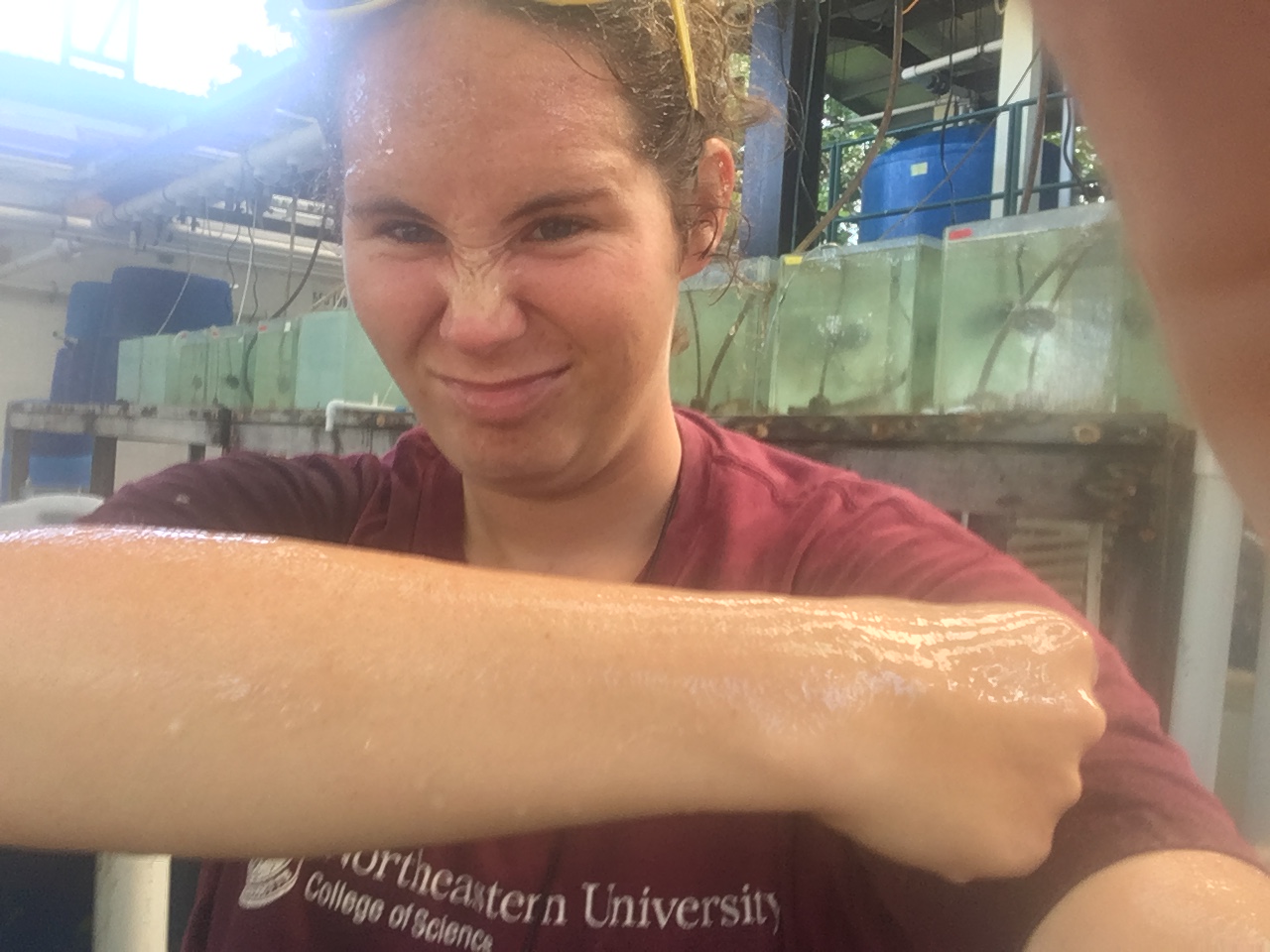
IMG_6992

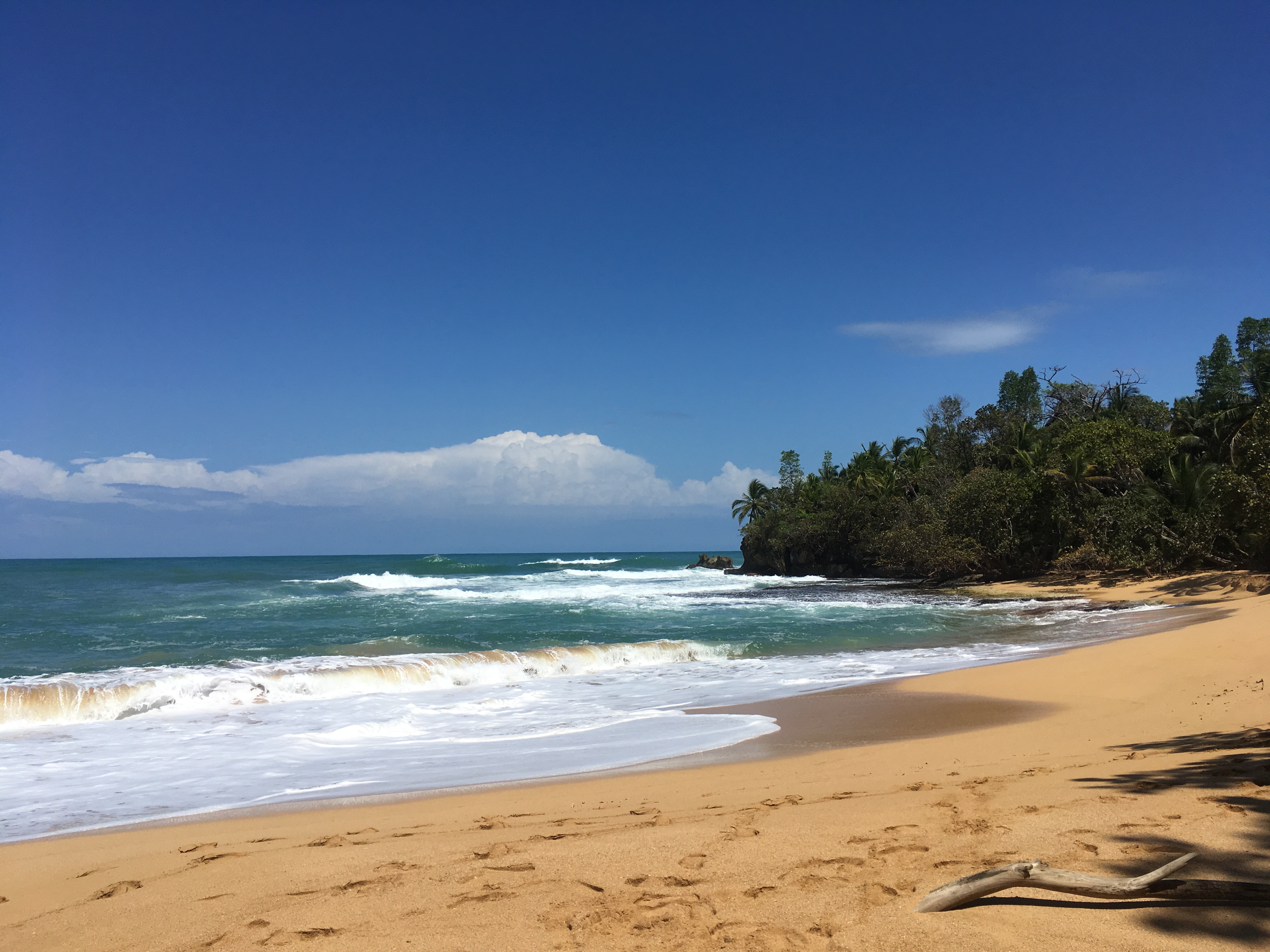
So I ran to the dock, then ran right off into the blue-green Caribbean waters, and I laughed. Because, even though at that moment in time, I felt a bit defeated by an animal without a brain, I couldn’t help but realize that I was happy. In the last year, I have struggled with the stress and demands of doing a Ph.D. and have questioned my choices multiple times. But in that moment, when things felt like they were falling apart, I fell back in love with my Ph.D.

Sometimes you just have to be forehead deep in the blasted-tissue of your study species, before you jump off a dock to remember that life is funny and you truly love what you do. The last year-ish of my life has been the craziest, stressful, adventurous, disgusting at times, wonderful, anxiety inducing, yet self-affirming, amazing time of my life, and I wouldn’t have it any other way. I’m going to miss Bocas and the #FieldWorkLife, but I can’t wait to get into my data and start piecing together my results.
IMG_7001.JPG

Previous Blogging Efforts

This is my most recent personal webpage… but the internet keeps everything, so here’s some old blogs and posts that I have created, as well as articles written about my research!

Best Fishes,
Sara